
How Contrasts Create Poems
Two Writing Prompts and Details about my Poetry & Architecture Course Starting this Wednesday!

First published on The Writing Tree’s Substack.
I recently travelled to the vibrant city of Albufeira in Portugal. In the Old Town, I was struck by the incredible contrast between these apartment blocks:
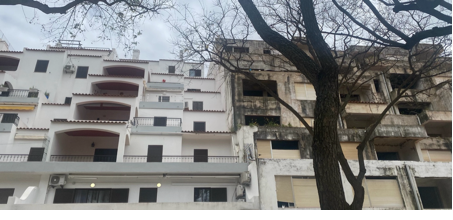
Looking at these, I felt moved. Both apartment blocks share the same structure and purpose, but only one has been revitalised. I don’t know whether the block on the right will be given a new lick of paint at a later date, but the difference between the two inspires me to imagine two buildings for a poem: one abandoned, and the other lived-in. One representing loneliness, and the other representing love. If I was to structure the poem in this way – beginning with loneliness and moving towards love – the buildings become symbols of celebrating connection.
It thrills me that in poetry, there is always movement from one thing to another, and it’s the same with architecture. The Chinese-American Architect I.M. Pei said: “Life is architecture and architecture is the mirror of life”. We could replace the word ‘architecture’ with ‘poetry’.
Buildings can tell us a lot about humanity. We look at new-builds and see the human desire to create; we study the weathered castle and see how history can be lost or preserved. Buildings, like poems, carry emotion.
Last year, I visited the Kingsgate Bridge in Durham, designed by the Architect Sir Ove Arup. At dusk, the concrete structure created the illusion of the river solidifying beneath. The scene was entirely grey – like fog over an English beach – and, of course, beautiful. The journey across the bridge reminded me of leaving a classroom at my rural-Somerset Primary School on a cloudy day, walking through the grey playground, and running down a little path to the hidden stream nearby.
Alongside immediate contrasts (like in the example above, of Albufeira’s Old Town), time contrasts – the contrast between past and present, for example – can support a poem’s structure. For example, I could begin writing in the present tense to describe my experience on Kingsgate Bridge, and contrast it with my memories of Primary School. I’d have to keep writing to discover the rest of the poem – why these images connect, or ‘feel’ the same to me. Perhaps it’s to do with capturing time: the river felt ‘suspended’, like my journey across the playground (I can’t remember past the point of reaching the stream – I probably had Conservation Club!). I always like to trust that the images or ideas coming to mind are asking to be written about (particularly if they come up regularly!).
Architect Peter Ahrends wrote of Sir Ove Arup: “In making this bridge, and in establishing the underlying spirit of his engineering practice, he imaginatively blurred all conventional edges between engineering and architecture, between art and science”.* This May, I’m very happy to be facilitating a course for The Writing Tree called Poetry and Architecture, and we will be blurring the edges of different art forms – and time periods – to write new poems. The course is for any level of writer (prose writers are welcome too!) who would like to write some new pieces inspired by buildings, structures, gardens, and ruins.
Exercise
Here’s a exercise you might like to try, which uses a poem to create contrast:
Read this poem – The House on the Hill by Edwin Arlington Robinson – and write a poem in response, describing what the house was like before it was abandoned. Try to create a contrast – the ‘before and after’: who lived there? What was life like? Focus on those classic 5 senses: sight, smell, touch, taste, and what can be heard from the house.
If you’d like an extra challenge, you could try the villanelle form, like Edwin Arlington Robinson does in his poem. The villanelle is a traditional French form: there are five stanzas (verses) of three lines each, and a final quatrain (four-line stanza). The first and third lines of the first stanza repeat alternately at the end of the following stanzas; except the final one, where they are repeated together as the final two lines of the poem. If you’re finding it difficult, don’t worry – Elizabeth Bishop went through 17 drafts to create her villanelle ‘One Art’!
*Accessed on 20.04.26 from The Royal Academy Website:https://www.royalacademy.org.uk/art-artists/work-of-art/record-drawing-of-kingsgate-bridge-durham-plan-north-elevation-and-detail
I’m delivering a Poetry and Architecture course for the Writing Tree, which begins on Wednesday 6th May, and runs weekly from 6.30pm-8.30pm for 5 weeks. I can’t wait to see what we construct together during the workshops. See you there!
(There are still a few tickets left, if you haven’t booked yours yet!)
This sounds fascinating, Georgia! I work in form a lot so I think of this relationship often.
Went to the National Poetry Library at the Southbank Centre a few weeks ago and they have an exhibition exploring the relationship between poetry and architecture. It was very interesting - from the ancient Sumerian Kesh Temple Hymn to the emergence of concrete poetry in the 1960s.
https://www.southbankcentre.co.uk/whats-on/poetry-buildings/